View all articles

With 01 May 2026 fast approaching, it has become very apparent on various online forums,
webinars, and at in-person events that there are three, maybe four, types of landlord. Firstly, there is the informed landlord who has followed the legislative reforms over the past few years and is pretty clued up. Then there is the one who learns on the go, i.e. when required to know something they look it up and ask around. Then there is the one who is disengaged and oblivious to the changing world. Of course, there is the rogue landlord who gives the majority of landlords a bad name resulting in more punitive legislation and more administration upon our shoulders.
With new legislation comes a relatively clean slate of what is expected from both the landlord and the tenant. Some case law will spill over, however, as with any new laws, there will be unforeseen circumstances and gaps creating doubt, potentially misuse, and split opinion on what the new act intended. This will create a flurry of cases over the years to come and we can only educate ourselves to the best of our knowledge. With c.170 different pieces of legislation and around 400 regulations which impact our properties as well as tenants, landlords are right to be anxious.
New legislation means a new regime and with that means new (or more punitive) enforcement penalties. I will attempt to cover some of the fines that landlords may face. As landlords we may feel that the new legislation is very much pro-tenant, and you wouldn’t be wrong as you may have noticed that the majority of official GOV.UK pages relating to the Renters’ Rights Act 2025, as the name suggests, aretenant-focussed, guides for tenants, tenant guidance, and of course, guidance for local authorities.
Local Housing Authorities Given New Investigatory Powers
Commencing on 27 December 2025, local housing authorities1 have acquired new additional powers to investigate both landlords and agents if they have broken certain laws as well as requesting information from a “relevant person(2)”.
A local authority may enter premises if there is a suspicion that a relevant person is running a rental sector business i.e. letting out residential premises. Most situations won’t require a warrant to enter, but there will be certain circumstances and requirements where a warrant will be required. In addition to the official Government’s guidance to local authorities, a renters’ rights charity, Shelter, has set out the different aspects(3) of a local authority’s powers to enter premises, request information and seize evidence in more layman’s terms..
Under previous legislation, a local authority was required to give the landlord 24 hours’ prior notice to enter the premises. However, as part of the biggest change in the council’s powers that landlords may find somewhat shocking is that the Renters’ Rights Act has removed this duty and only imposes a requirement to notify the landlord that the property was entered with date and purpose. Will this give rise to a volume of vexatious complaints to the local authority by tenants where there has been a communication or relationship breakdown with the landlord and with the councils seeing a potentially lucrative income stream from the new enforcement penalties?
1 Investigatory powers guidance for Renters’ Rights Act 2025
2 Powers to enter a business premises
3 Local authority investigatory powers
Civil Penalties issued by Local Authorities
As part of the Renters’ Rights Act, alongside these newly-acquired new powers, local authorities will have from 01 May 2026, a larger “menu” of civil penalties to issue for breaches and offences which carry a maximum of £7,000 and £40,000 respectively.
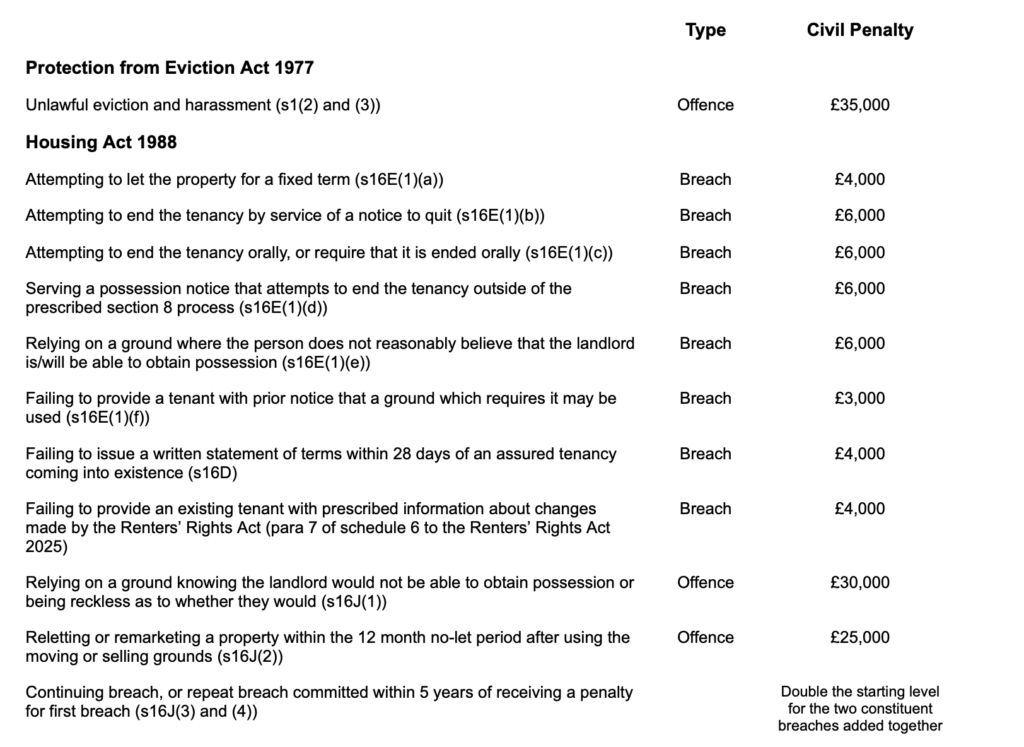
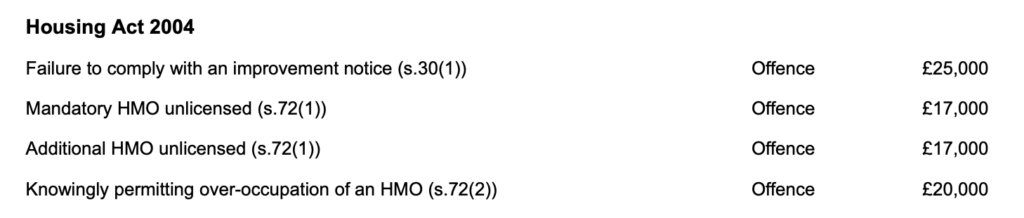
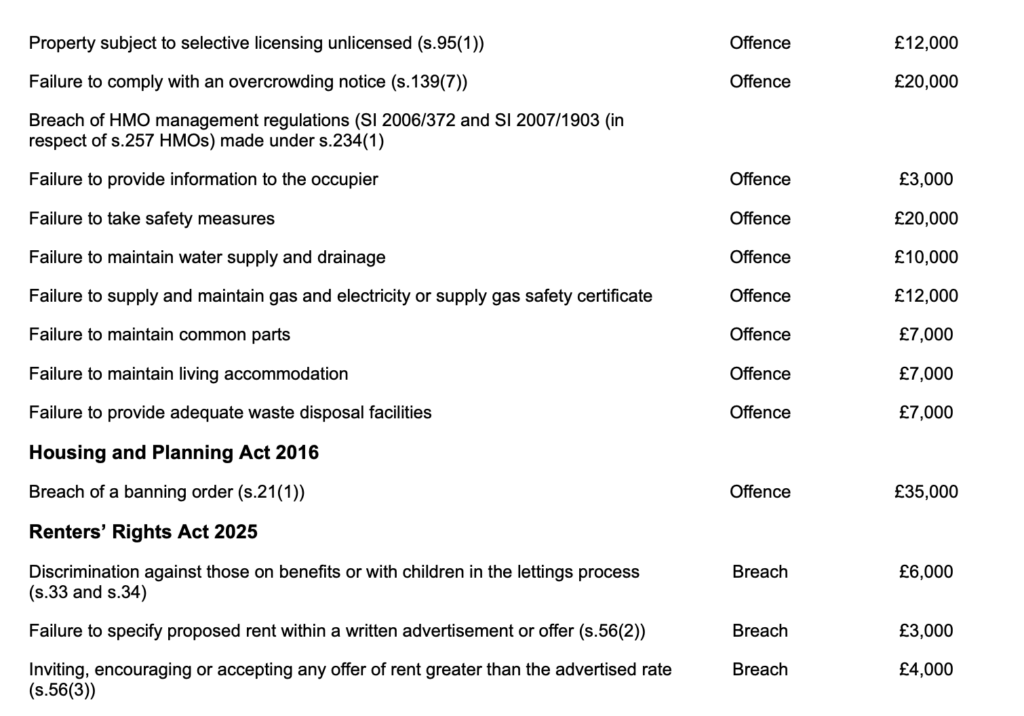
Landlords’ first pitstop to avoid a penalty of up to £7,000 (first breach £4,000) is to serve the Renters’ Rights Act 2025 Information Sheet by 31 May 2026. If there is an agent acting on behalf of the landlord, the onus falls onto the agent, although it is not very clear who would be liable if an agent failed to serve the required prescribed information to all named adult tenants neither is it transparent whether the information needs to be served to any guarantors.
Rent Repayment Orders (RRO)
On the flip side of the coin, whilst local authorities have gained more investigatory powers and the ability to issue higher financial penalties on the landlord, at the same, the tenant will be able to make a Rent Repayment Order claim in an expanded number of situations.
RROs were first introduced in England and Wales by the Housing Act 2004 initially within the HMO sector and later extended under the Housing & Planning Act 2016 to embrace a wider array of offences and enabling tenants to reclaim up to 12 months’ rent. This maximum is going up to 24 months’ rent from 01 May 2026. It is a mechanism to force a landlord, via the First-tier Tribunal, to repay an amount of rent to the tenant or local authority.
The offences that give rise to a potential RRO are being expanded under the Renters’ Rights Act(4).The RRO guidance(5) for tenants provides a list of offences (and relevant legislation) as follows:
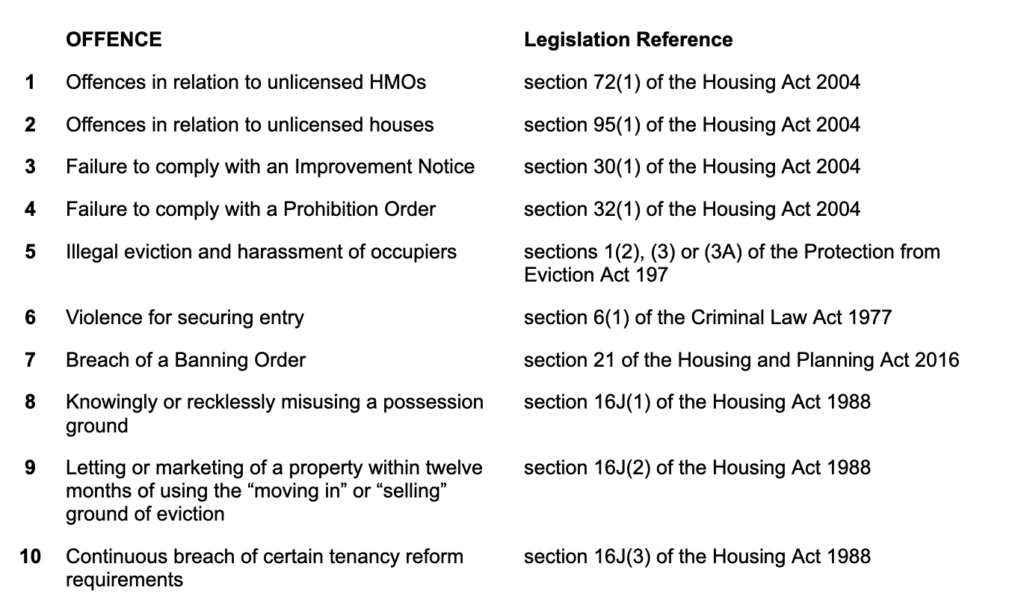
In addition to the first seven offences, the additional three offences listed are the new ones coming into force on 01 May 2026. 8 and 9 are rather self-explanatory and are directly linked to the possession grounds under the new section 8(6). The last offence listed is where a landlord has had a penalty imposed and the landlord’s conduct persists beyond 28 days establishing a new offence.
What is also important to note is that where the landlord is a company and the company commits an offence, the officers are also individually liable if the company acted with their consent, connivance or neglect.
As the old adage goes, prevention is better than cure so how does a law-abiding landlord go about checking if their house (‘scuse the pun) is in order? There isn’t an abundance of obvious help for landlords and often you would have to look in various places to see if you are following the rules or have inadvertently breached a nationwide or a local legislative requirement. Seeking specialist legal advice to understand what is relevant or what has gone wrong can be expensive, however, I would recommend reading up on the guidance offered to tenants and local authorities which provide great insight into how a penalty can be enforced against you and the process if you find yourself in hot water.
Rent Repayment Orders offences: guidance for tenants
4 Guide to Renters’ Rights Act 20255 Rent Repayment Orders: guidance for tenants
5 Rent Repayment Orders: guidance for tenants
6 Grounds for possession: guidance for landlords and letting agents
Rent Repayment Orders: guidance for tenants
Rent repayment orders: guidance for local authorities
With so many changes in the private rented sector for a generation, landlords have to be on the ball more than ever but at the same time wary of incorrect information and advice being spouted from unknown sources. I am hoping that whichever landlord you are, that you are not going to be the one with the wrong information!
On a sad and poignant note, I would like to pay tribute to a very knowledgeable lawyer, a housing law giant. Giles Peaker passed away on the weekend. He was a partner at Anthony Gold solicitors but also taught and shared his knowledge to many. I was very lucky to have been taught by GIles of the ins and outs of housing law. Whilst Giles was an outstanding solicitor and one of the architects behind the Homes (Fitness for Human Habitation) Act 2018, he will be best remembered by landlords and tenants alike for his “Nearly Legal” ‘blogging’ website which resembles a bible of case law and commentary on housing, landlord and tenant legislation.
Notes to Editor
This month, my colleague Joanna Dabrowska has written this important update on my behalf. Joanna has been a self-managing accidental landlord in West London since 2018. Originally working within the airline and airport industries supporting IT projects and later as a management accountant, Joanna consolidated her skills into business transformation and management consultancy.
In parallel to her corporate life, Joanna was a four-time elected borough councillor with portfolios in planning and transport strategy. Following the 2019 general election, she was offered the opportunity to work in Parliament supporting MPs in various constituencies around the country where her intrigue for the private rented sector and its legislation blossomed.
Last year, Joanna agreed to join me in running a popular and well-respected Landlord & Tenant Advice UK group on Facebook with over 47k members! She also provides landlord compliance, advisory on regulatory affairs and administrative support outside of the group. Joanna is opening up her own lettings, property management and consulting agency in due course. Her dream is to one day own a smallholding with a small flock of sheep and live “the good life”!
Disclaimer
This article is for general information only and is not legal advice. Landlords should check the latest GOV.UK guidance and seek professional advice on their specific circumstances.